
Roof Documentation for Insurance Adjusters and Restoration Firms in Missoula, MT
Insurance Adjusters and Restoration Firms
On a Missoula, MT claim, the order of the first visit decides how much of the loss can be proven. If the tarp goes on before the damage is photographed, the evidence is under the tarp. If the snow is cleared before the drift lines are recorded, the load that caused the collapse is gone. We run the first day in a fixed sequence: make the roof safe, photograph everything where it lies, then stop the water. Each step gets a time and a photo, and the record goes to the adjuster and the restoration firm in the same hour.
An adjuster needs what the roof looked like, what the event did and what the repair costs by line. We write all three.
Know the events that damage roofs here
Four events matter in this market. Snow load is the first: Missoula's design ground snow load is 40 psf, and the city averages about 39.5 inches of snow a winter. Much of the former Bonner mill roof came down under heavy snow in 2011, which shows what an unchecked load path can do. Hail is the second. In 2016 quarter-size hail and a 20-minute downpour hit central and south Missoula and overwhelmed storm drains.
Wind is the third, and the design wind for a Risk Category II building here is 102 mph. Heat is the fourth: the record high is 107 degrees on June 30, 2021, and daily swings average more than 30 degrees from late June through late September. Heat is mostly age, and not a claim, but it affects how old damage looks next to new.
Each event leaves a different mark, and each needs a different record.
Where the event hit matters to a carrier. A storm on central and south Missoula is not a storm in Lolo or Florence, and a drift on the University District campus is not a drift in Potomac, which averages 51.8 inches of snow a year. We tie each claim to the place it happened and to the readings that apply there, and we avoid borrowing a number from the next town.
Separate the event from old wear
Carriers pay for sudden events, not for age. A Missoula roof carries both. About 45 days a year never rise above freezing, and thaw cycles work seams and flashings every year. A cracked sealant bead may be old. A fresh dent in a vent cap is not.
We record both and label them. Fresh damage shows in debris patterns, clean breaks and bright metal at a new dent. Old wear shows in dirt in the crack, oxidized edges and rust. Each finding gets a photo, a location on a plan and a date. That gives the adjuster something to check, and it gives the owner a plain reason why some items are in the claim and others are maintenance. Our claim documentation follows the same structure each time.
Records from before the loss help most. A dated photo set from a spring or fall walk is the best baseline, because it shows the roof as it was. If no baseline exists, we build one from what we see and say which parts we could not confirm. Many claims turn on that one distinction.
Map hail hits before the next storm
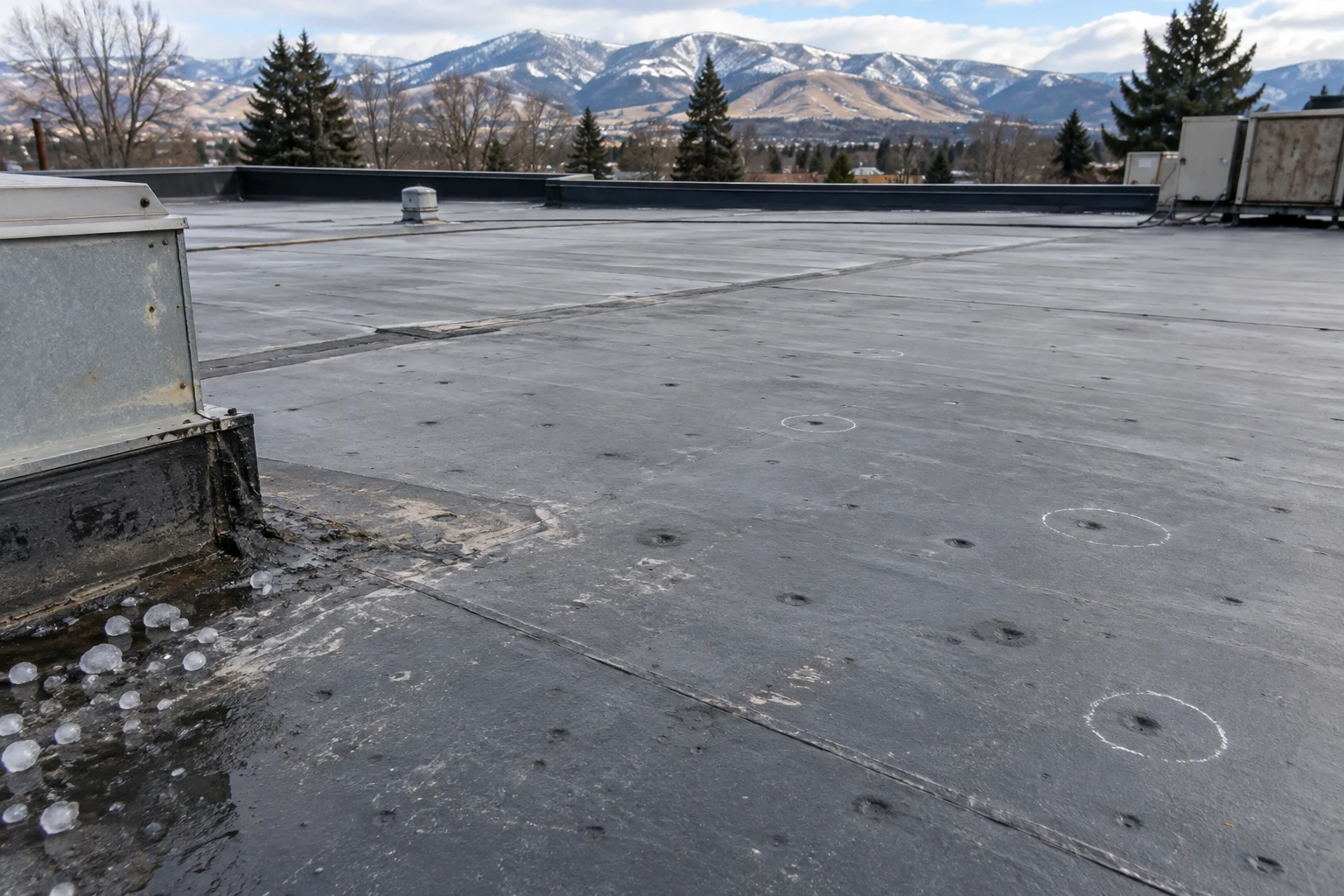
Hail is the most debated item. A bruise on a single-ply sheet can hide a cracked insulation board below. A dent on a metal panel may not leak, but it marks a seal that will fail first. We press, probe and, when allowed, take a core. A test square marked on the roof counts hits per area, and photographs with a scale reference let the adjuster measure.
Our hail damage repair work starts with that map. The repair scope follows it, with quantities by section. A few hits mean patches, and many hits move the scope toward a section or a roof. Retail roofs along the North Reserve Street corridor, where stores share drains, need the hit count by tenant space as well.
Metal roofs show different signs. Hail dents panels and ribs, wind lifts caps and ridge pieces, and thin metal can crease at a fastener row. We photograph dents with a straight edge and a scale so depth is visible, and we check laps and fasteners, since wind can loosen them without leaving a mark.
Record snow and ice before the thaw
Snow load claims are time-sensitive. A drift melts, and the evidence of its depth goes with it. We photograph drift lines, measure depth where we can reach and note the location of every sag, buckled purlin and cracked fastener. Ice dams leave marks at the eave and ceiling stains below. Our snow and ice damage repair work records them in the same dated set.
Where a deck or framing shows distress, we recommend an engineer review before anyone walks the area again. We do not stamp structure, and a roofer who guesses about it creates a second loss.
Run the first day in order
The first visit has three jobs. Make the roof safe. Photograph before anything moves. Stop the water. We answer at any hour, and emergency roof repair starts with temporary measures: tarps, sealing and drain clearing. Each is priced as temporary, so the carrier sees what was done to limit loss and what remains.
A written log shows who did what and when. Receipts, crew times and photos belong in it. A drone roof inspection shows a large roof quickly and keeps people off an unstable surface, which helps when snow or ice covers it.
For critical buildings, such as clinics, we talk to facilities about which rooms are at risk. The health system roofing plan protects care spaces first. When a loss involves a rebuild, we coordinate with the general contractor so the roof sequence matches the interior schedule.
Write the scope the carrier can rule on
A scope for a carrier names the roof system, the damaged areas by location and quantity, the repair method for each, the material and labor items and any code upgrade or matching issue. Montana's energy code, the 2021 IECC with state amendments enforced since June 10, 2022, can affect insulation on a replacement, so that line is marked separately.
Line items stay separate from temporary work and from maintenance, so the carrier can accept, adjust or deny each on its own terms. We offer a joint walk with the adjuster and bring the photo set so both sides start from the same record. The finished file goes to the owner and to whoever the owner names.
Related Roofing Pages
Send the loss date and the building address
Send the loss date, the building address and any carrier contact, and we will schedule the first visit, secure the roof and return a dated scope that separates temporary from permanent work.
Call 555-555-5555 or email [email protected].
Questions About Insurance Adjusters and Restoration Firms
Can you meet the adjuster on the roof?
Yes. We schedule a joint walk when the carrier asks for one and bring the dated photo set and the roof plan. Access and safety gear are arranged in advance.
How soon after a storm should the roof be walked?
As soon as it is safe. Debris moves, snow melts and a second storm can erase hail marks. A drone pass gives a first look when the surface is wet or icy.
What if the carrier approves less than the full repair?
We give the owner a written list of what is covered and what is not, with a price for each. Items not covered stay on the list with their prices.
How long do temporary repairs hold?
Through ordinary weather, usually. A second storm or a hard freeze can test them. We note an expected life for each measure and suggest a check after any major wind, hail or snow event.
Can restoration firms work below once the roof is dry?
Yes. Once the roof is dried in and the entry points are sealed, we tell the restoration firm when interior drying and demolition can start without more water coming in.