
Commercial Roofing on North Reserve Street, Missoula, MT
North Reserve Street
On a retail roof, the sequence starts at the front door, not the roof edge. Snow that slides off a warm roof lands on whatever is below it, and below a big-box entrance that means carts, customers and delivery trucks. Reserve Street is one of the busiest streets in Montana, carrying more than 30,000 vehicles a day and including one of the main Interstate 90 on and off ramps. Costco, Lowe's and Walmart are the large names on the corridor, with Hilton Garden Inn, Courtyard Marriott and Homewood Suites hotels nearby.
We repair, replace, recover and maintain commercial roofs along North Reserve Street in Missoula, MT. Every job starts with a plan that shows where snow falls, where trucks stage and which doors stay open. Material is ordered after that plan is approved, not before.
Find the failure that closes a store first
In retail, the roof failure that matters is the one over the sales floor, the stock room or the guest corridor. A leak near a freezer case, an electrical panel or a bed is a closure risk, and it is rarely the roof's largest problem. We begin the walk at those spots and work outward, tracing each stain back across the deck to the flashing, seam or drain that caused it.
A water stain on a ceiling is a poor guide to the source, because water travels along the deck before it drops. We mark the stain, then follow the slope uphill and probe every seam and curb in the path. The finding goes on the sheet with a photo of the stain and a photo of the cause.
Control snow shed over entries and drive lanes
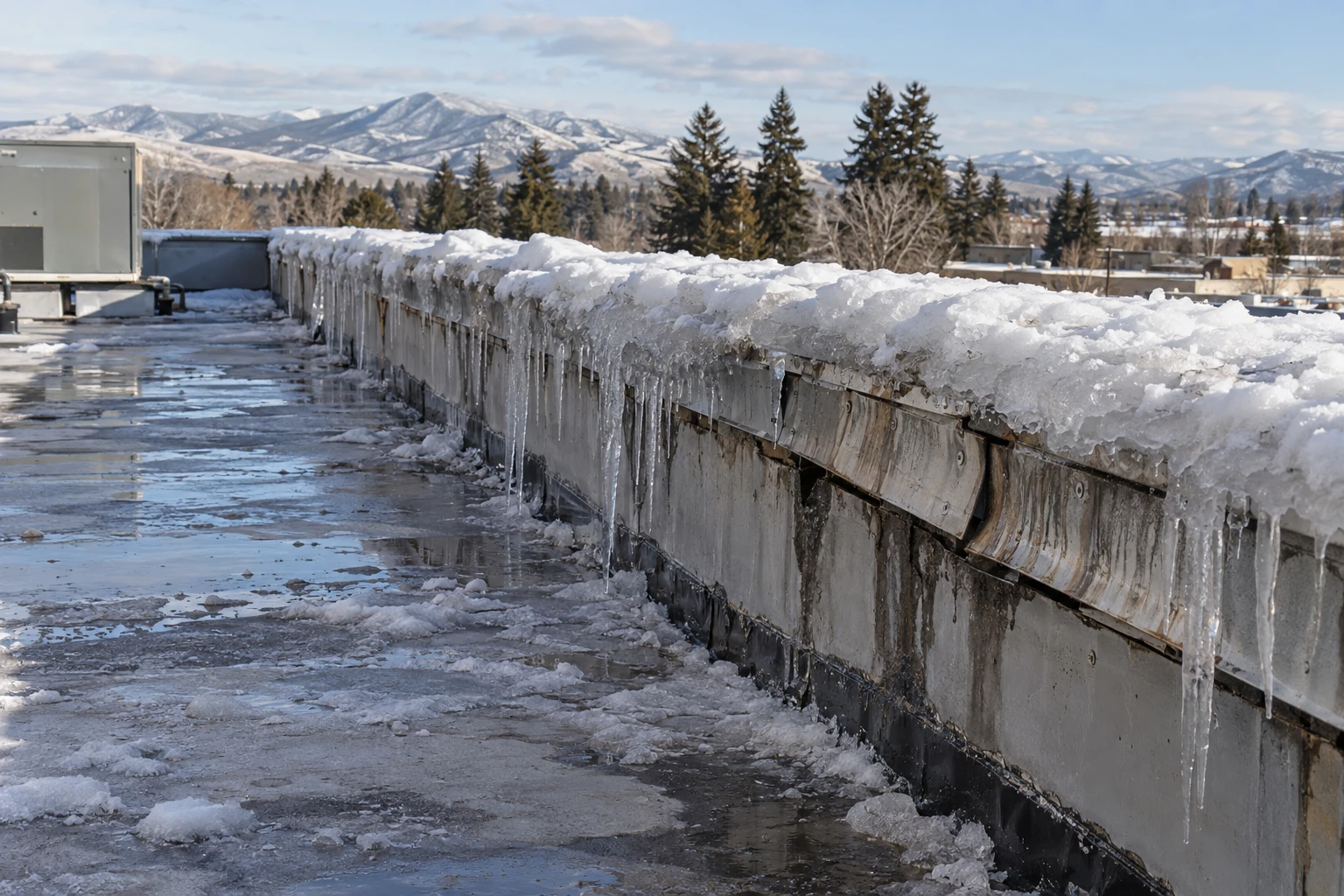
The design ground snow load is 40 psf. A winter here brings about 39.5 inches of snow, with ground cover for roughly four months, and freezing holds all day on about 45 days. On a large retail roof, those numbers produce a steady thaw cycle: snow melts at the warm center, runs to the cold edge and refreezes.
The edge is where trouble shows up. Ice forms at gutters and parapet scuppers, a slab of snow lets go over a doorway, and a drive lane gets blocked. We check snow and ice damage at every entry, add snow guards where a metal edge or slope calls for them and clear drain sumps ahead of the first heavy thaw. For a big-box roof, the guard layout and the entry list are part of the written scope.
Phase the tear-off around store hours and truck traffic
A retail owner cannot close a store for a roof. So the phasing sheet divides the roof into bays, and each bay is sized to be torn off, insulated and dried in within a single dry-weather day. We start with the bays farthest from the entrances and finish near them, so customer access is least disturbed at the end.
Deliveries are the next constraint. Dock doors need clear approaches in the morning, and the crane pick or material hoist cannot block them. We set the laydown yard in a corner of the lot, fence it and keep it small. The staging area appears on the roof plan along with fire lanes and handicap parking. If the lot belongs to a landlord, the landlord signs off on that plan before material arrives.
Weather decides the last piece. We hold a short list of fallback tasks, such as drain clearing and curb work, for days when tear-off is not safe. The crew still has useful work, and the open bays stay small. No bay opens unless the forecast supports closing it, since an open bay in a storm is worse than the leak that started the job.
Time hotel roof work around guests
Hotels nearby follow a different rule. Guests sleep during the day as well as at night, and the rooms under the work are the ones that complain first. A hotel roof job sets quiet hours, blocks the top floor rooms under active work and routes debris chutes away from windows and entrances. Housekeeping and front-desk staff receive the daily plan each morning.
Rooftop equipment on a hotel, such as makeup air units and exhaust fans, needs careful handling. A curb that is raised or relocated affects ductwork and electrical, so the mechanical contractor joins the sequence. Our equipment curb and support work is planned with that contractor, not around them.
Prepare drains and edges for hail and cloudbursts
The 2016 cloudburst over central and south Missoula, hail included, shows what a short burst does to any large paved district: roofs shed water fast, parking lots shed it faster, and the storm system backs up.
For a big retail roof, the response is simple. Clear every drain sump before spring. Check overflow scuppers so a blocked drain does not pond the whole field. Walk the roof after any hail event, and look for bruises on the membrane, dented metal and displaced granules on any cap sheet. Edge metal and perimeter fastening are rechecked each year against Missoula's 102 mph Risk Category II wind speed. A loose edge is a repair visit in the fall and a replacement scope after the first big wind.
Match the system to the traffic on the roof
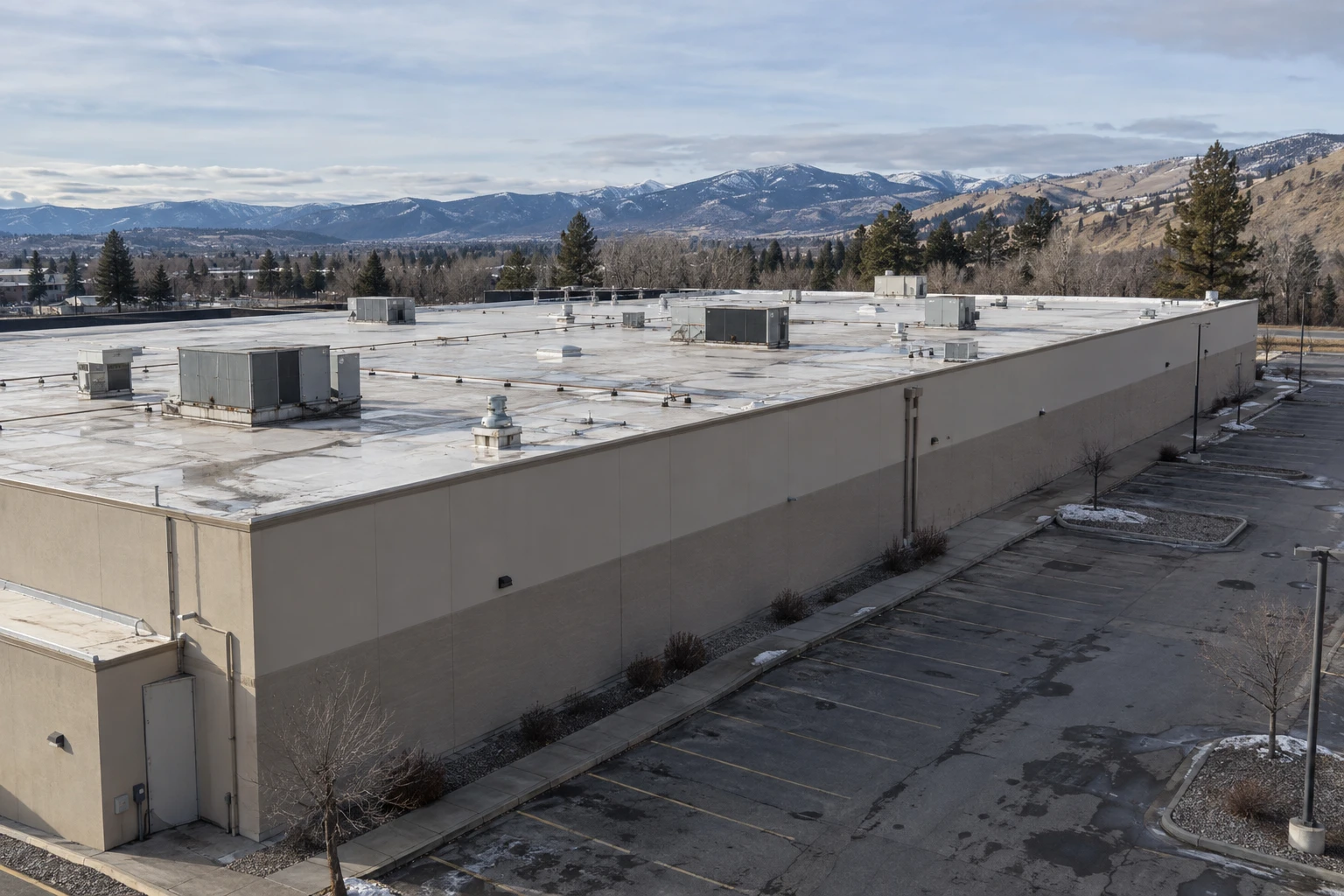
Buildings listed along and off Reserve Street run from about 7,012 square feet to about 28,512 square feet, the larger with 23-foot ceilings and grade-level loading. Those sizes tell us nothing certain about the roof on top, and we do not guess. We measure and probe each one.
On a large retail field, a reflective single-ply sheet such as TPO is a common candidate because it welds into continuous seams and reflects summer sun. Late-summer swings of more than 30 F and the winter freeze both work the sheet. Where service traffic is heavy around rooftop units, walkway pads protect the sheet along the paths that crews use.
Walk the punch list before the crew leaves
The close-out walk covers each flashing, each drain and each curb against the plan. The punch list is dated, and open items get an owner. The roof file takes the finished-work photos, the warranty terms and the drain map, so a later manager can see exactly what was done.
Owners who also hold property near the Brooks Street and Southgate Midtown area, or in the development park near Mullan Road, can run those roofs on the same format. A yearly maintenance visit keeps drains clear and edges tight between larger projects.
Related Roofing Pages

Send the roof plan and store hours
Send the roof plan, the store or occupancy schedule and the delivery windows, and we will map the phasing and staging before any material is ordered.
Call 555-555-5555 or email [email protected].
Questions About North Reserve Street
What decides whether a retail roof is replaced or recovered?
The condition of the insulation and deck under the old membrane. If both are dry and sound, a recover can avoid tear-off. If the insulation holds water over a broad area, replacement is the cleaner path.
How are customers kept safe during tear-off?
With fenced staging, marked fire lanes and entry protection. Work over doorways is done when the store is closed or the entry is shut, and the plan names who closes it.
Can roof work continue during the holiday season?
Large scopes avoid it. We schedule heavy work in the spring and summer weather window and keep holiday weeks for emergency repair only.
What decides the number of snow guards?
Slope, edge type and what lies below. A metal edge above an entry gets full coverage. A membrane edge over a service yard may need none.
Who signs off on the staging plan?
The property owner or landlord, plus the tenant where the lot is leased. A single sheet carries the laydown yard, fire lanes and truck routes.